Here is a scenario playing out in Munich procurement offices right now.
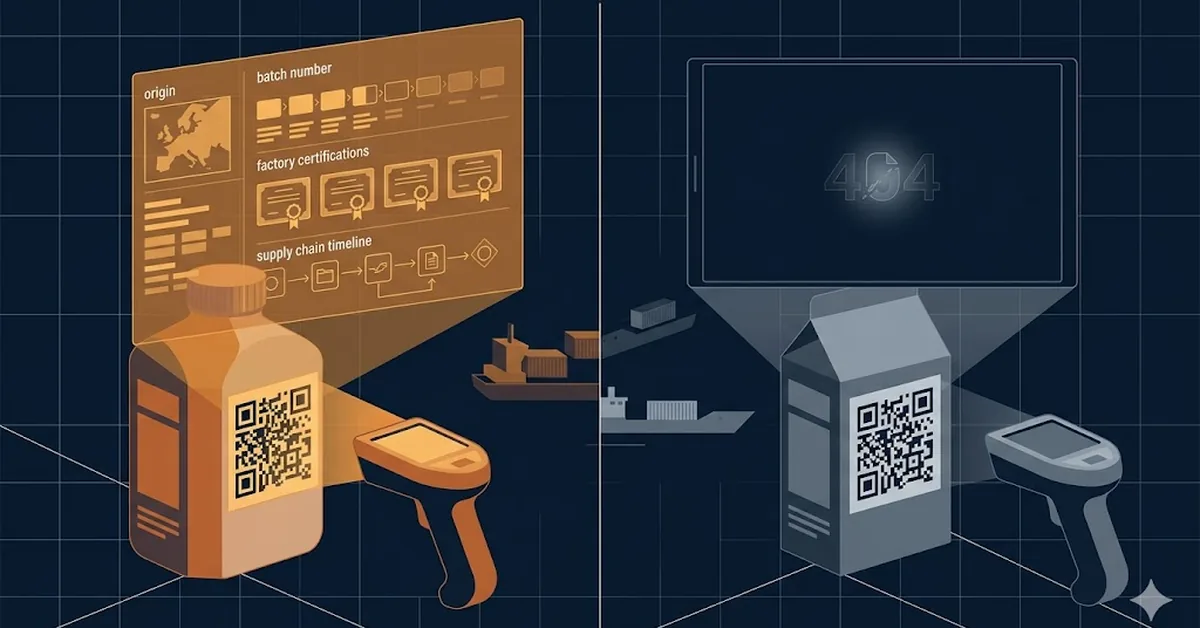
A buyer is evaluating two Indian textile suppliers. Same price. Similar quality. They scan the QR code on a sample from each. One returns a rich product record: batch origin, material composition, factory certifications, shipping history. The other returns a 404, or a static PDF, or nothing at all.
The contract goes to the first supplier. The second never finds out why they lost.
This is what GS1 Sunrise 2027 actually means. Not a barcode format change. A change in what buyers can see and what they will expect to see. The companies that have their data infrastructure ready when buyers start using it will have a structural advantage. The ones that treat it as a printing problem will lose business they cannot trace back to this decision.
What the Sunrise deadline actually is
GS1 Sunrise 2027 is the point at which major global retailers commit to scanning and processing 2D barcodes at checkout. Over 60 retailers have committed: Walmart, Kroger, Carrefour, and Woolworths among them. Pilots are live in 48 countries covering 88% of global GDP. By end of 2027, a product that cannot serve structured data via a 2D scan will be invisible to modern retail systems.
The transition has two parts that almost every explainer conflates.
The first part is the label. Replacing a 1D EAN-13 barcode with a GS1 QR code or DataMatrix code. This is what hardware vendors and label printers talk about. It is the easy part.
The second part is the data. When a retailer scans that QR code, the GS1 Digital Link URI in the code resolves to a web address. That address is supposed to return structured product data: GTIN, batch, expiry, compliance certificates, event history. If there is no system behind that address, the scan returns nothing useful.
Most Sunrise 2027 readiness conversations are entirely about the first part. The contracts will be won or lost on the second.
Printing a GS1 QR code is the easy part. The contracts will be won or lost on what that code resolves to when a buyer scans it.
Why this lands differently for Indian exporters
For a European retailer or a US distributor, Sunrise 2027 means updating scanners and backend software. Their supply chain data systems already exist. They are upgrading infrastructure that is already there.
For an Indian exporter, the problem is upstream. The data systems often do not exist.
India has a real head start in one sector. The government mandated GS1-based QR codes on the top 300 pharmaceutical formulations. DGFT requires GS1 barcodes for drug exports. That infrastructure is partially functioning.
But the mandates Indians export into are expanding far beyond pharma.
The EU Digital Product Passport regulation requires structured traceability data for batteries from February 2027, textiles and apparel from mid-2027, and electronics, furniture, and steel to follow. The GS1 DPP Provisional Standard defines the technical spec: three mandatory data layers including EPCIS events and a GS1 Digital Link resolver. India exports into every one of these categories. FSSAI is moving in the same direction for food, with no hard mandate yet but clear regulatory intent. In the United States, FSMA Section 204 has already set the equivalent standard: lot-level event history for high-risk foods, retrievable in 24 hours. The trajectory for food traceability is consistent across markets.
The intersection is what makes this urgent. Sunrise 2027 creates the scanning infrastructure. EU DPP specifies what data must flow through it. An Indian exporter that can print a GS1 QR code but cannot serve event-level product data when that code is scanned is not ready. Regardless of what their label looks like. The category-by-category data gap diagnostic for Indian garment exporters breaks down exactly where that readiness deficit sits across all nine EU DPP attribute categories. And the buyer-side procurement clauses are not waiting for the regulation: see what an EU buyer’s DPP RFQ is already asking for in 2026 textile contracts.
Three things that have to be in place
I build supply chain data systems. We played the primary role in architecting, designing, and building the backend for a Food Traceability Platform operated by GS1 Germany and Benelog GmbH, which connects 770+ enterprises across 30 countries in Europe. We are a core contributor to OpenEPCIS, the open-source EPCIS 2.0 implementation led by benelog GmbH. This is the infrastructure that makes traceability data flow. So when I look at Sunrise 2027 readiness, I look at three things.
Identifier coverage. Every product you export needs a GTIN. Every location needs a GLN: factory, warehouse, dock, distribution point. GS1 India manages this. Most companies that have done any GS1 work have partial coverage. The gap is almost always in GLNs for non-primary locations, and in GTINs for the long tail of SKUs. You cannot generate event data for products and locations you have not identified.
Event capture. EPCIS is the GS1 standard for recording what happened to a product at each step in the supply chain. When was this batch produced? When did it ship from the factory? Which warehouse received it? What was the cold chain profile? These events, structured in EPCIS format, are what a GS1 Digital Link resolves to when a buyer scans the code. Without event capture, the QR code is a label. With it, the QR code is a history.
This is the gap most Indian exporters are not talking about. GS1 India has built the identifier infrastructure. Very few Indian supply chain software systems can generate EPCIS events today.
Companies have GTINs. They have barcodes. What they don’t have is the event history. And when a buyer scans the QR code in 2027, the event history is what they’re going to see. Or not see.
A resolver. A GS1 Digital Link URI needs a resolver service. It receives the scan request and returns the right data for that product. Product page, compliance certificate, traceability record. Who runs the resolver, what data it serves, and how it connects to the event repository is a systems decision that needs to be made before the label is printed.
Most readiness conversations get to the first item and stop. The second and third are where actual readiness lives.
The implementation gap GS1 India has not closed
GS1 India has done serious work. The membership infrastructure is solid. DataKart Trace exists. India hosted the Global General Assembly in 2025. The identifier layer is further along than most markets at a comparable stage.
What does not exist yet: no amount of GS1 membership or barcode printing will create the system layer between having GS1 identifiers and having a data infrastructure that captures, stores, and serves supply chain events in EPCIS format.
Companies have GTINs. They have barcodes. They do not have the event history. And when a buyer in Munich scans the QR code on their product in late 2027, the event history is what they are going to see. Or not see.
OpenEPCIS addresses exactly this gap. We contribute to that foundation and build production traceability systems on top of it. Not compliance strategy. We are engineers, not regulatory consultants. The technology that makes compliance possible. An EPCIS repository that captures events, a GS1 Digital Link resolver that serves them, and integrations that connect to whatever ERP or WMS the exporter runs.
What to do before the window closes
Three concrete things worth doing this week.
Check your GTIN and GLN coverage. Run the audit across every export SKU and every location in your supply chain, not just the top ten. Gaps tell you how far behind you are on the foundation before you even get to event data.
Ask your buyers directly. “What traceability data will you require from suppliers by 2028?” Some have already written this into procurement criteria. Others have not started. Either answer is useful. Silence from your buyer is also an answer. It means you have a window to get ahead of the requirement before it becomes a condition of renewal.
Test your systems against EPCIS. Ask your engineering team to produce a valid EPCIS event for the last shipment you sent. Any shipment. One ObjectEvent, with real data. If that takes more than an hour, you have a systems gap. If nobody knows what an EPCIS event is, you have a larger one.
The battery passport deadline is February 2027. Textiles follow mid-2027. The build window is open now. The companies that close this gap in the next six months will have the infrastructure in place when buyers start requiring it. The companies that wait will be reconstructing event histories from spreadsheets during procurement reviews and wondering why they keep losing on something that was never about price.
The companies that wait will be reconstructing event histories from spreadsheets during procurement reviews. They will keep losing on something that was never about price.