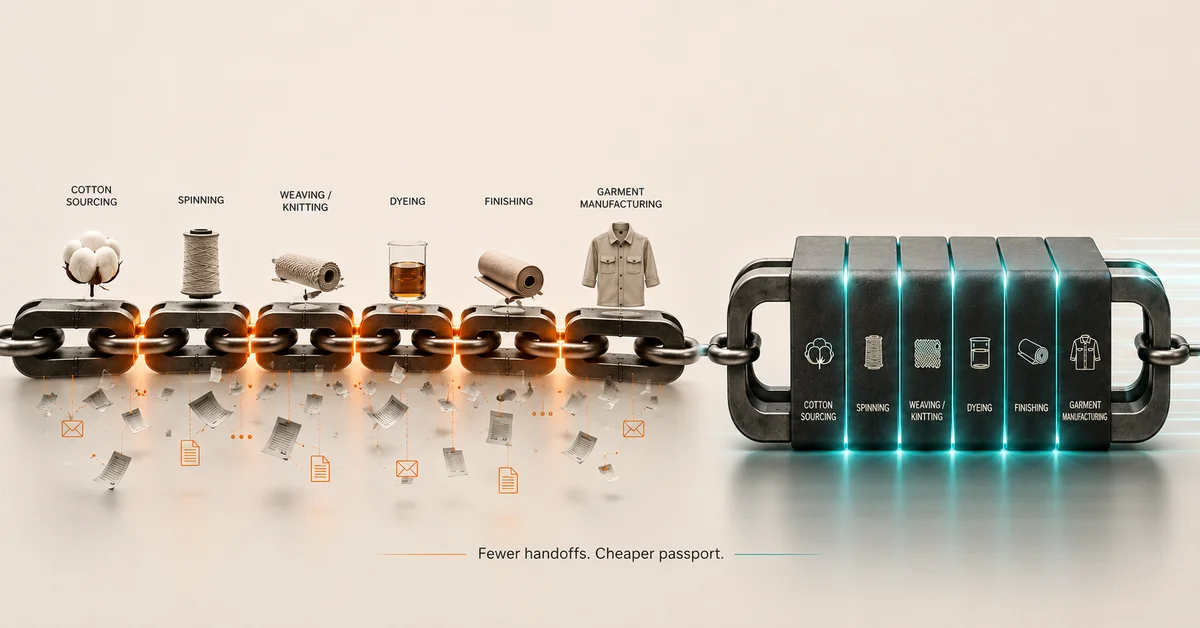
Most Indian textile owners might have built vertical integration for margin or quality control reasons. Yarn under one roof. Fabric next door. Dyeing in the same compound. Finishing before the lot leaves the gate.
The original spreadsheet was straightforward. Lower input cost. Faster cycle time. Less working capital tied up in middlemen.
That was the strategy until 2024.
Then the EU started building the textile delegated act under ESPR. The act is still in preparatory work, with the Commission proposal expected later this year and enforcement expected in late 2027. The brand procurement teams are not waiting for any of that. They are writing data clauses into 2026 contracts now.
The same vertical footprint, built for margin, is doing something the original spreadsheet did not model. It is collapsing the cost of producing a passport-ready SKU.
The pattern below is what I see from the systems side as a software architect’s lens. People with twenty years inside the mill will know the operational shading better than I do.
The DPP cost equation in plain English
Here is how the cost of a passport-ready SKU actually breaks down. It is less about technology than people expect.
Every additional supplier in your chain is another integration project. Another contract clause about data. Another email thread about a missing certificate. Another translation between their format and yours. That translation tax scales with every extra supplier and every extra buyer.
The math is boring. The math is also the answer.
Five outside suppliers per SKU means five chase cycles. Three outside suppliers means three chase cycles. Zero outside suppliers means the data is already in your own systems, owned by people on your own payroll, sitting in databases your IT team already supports.
I would not call this insight if I were inside the mill. From the outside, building data systems, the difference between five integration partners and one is the difference between a project and a feature.
Three exporters, three cost curves
Take three Indian exporters bidding for the same EU brand order. Same product. Cotton T-shirt, 10,000 units, GOTS organic, dyed and finished in India, cut and stitched in India.
Exporter A. CMT-only.
A runs a stitching unit. They buy fabric from three different mills, depending on price that month. The yarn behind that fabric comes from two spinners. The cotton came from three ginners. For one PO, A has eight upstream relationships to manage.
When the brand asks for country of origin per processing stage, allocated water per kg, and batch-linked dye chemistry, A has to reach into eight different systems, each owned by someone else, each on a different stack. None of those eight have a contract clause that compels a two-day response. Most of them have never been asked the question before.
Exporter B. Partial VI.
B owns weaving and dyeing. Buys yarn from a long-term spinner. Cotton comes via the spinner. Three upstream relationships, two of them long-running.
Same data ask. B answers the dyeing and weaving questions from internal systems. The yarn and cotton questions still need outside calls, but to two parties who already know B’s data pattern and have a reason to respond on time.
Exporter C. Full VI.
C runs a cotton trading desk, spinning, knitting, dyeing, finishing, and CMT, all under the same group. Some sites in Coimbatore. Some in Tirupur. Some in Gujarat. One ERP backbone. One sustainability head with reporting lines into every plant.
Same data ask. C produces the answer from inside the group. The cotton bale receipt is in the same accounting system as the dye batch record. The water meter at the dyehouse reports to the same internal team that owns the SKU master.
Three exporters. Same order. Same data ask. Different cost of producing the same answer.
The fields the EU brand is asking for do not change. What changes is whose computer the answer lives on.
This is the part the original margin-driven spreadsheet did not show.
Mass balance is harder across companies than inside one
One detail worth slowing down on. Cotton mass balance.
When spinning happens, 30 to 60 cotton bales blend at the lay-down. A specific yarn cone cannot be honestly traced to a specific bale. This is physics, not a software gap.
The honest answer has historically been mass-balance attestation. While broad, corporate-level mass balance (like BCI) is accepted for generic sustainability targets, the EU DPP will increasingly demand physical segregation or transaction-certificate-backed traceability (like GOTS or GRS) for explicit product-level claims.
Running a tight, certificate-backed chain of custody across one company is hard. Running it across five independent companies, each tracking their own inputs and waste factors in their own unlinked ledgers, is a compliance nightmare. The math is the same. The reconciliation is not.
A full VI exporter has the spinner’s bale receipts and the dyer’s fabric meterage in adjacent rows of the same database. The aggregate origin mix is a query. The CMT-only exporter has the same information sitting in five different inboxes. Whether the answer comes back is a function of vendor goodwill and email response time.
The competitive flip
Vertical integration earned its margin payback ten years ago. The new payback is procurement preference.
The buyer’s procurement team is not running on charity. They run on slot ranking. Suppliers who can answer a data request in two business days move up. Suppliers who take two weeks move down. The slot ranking compounds across seasons.
Two equally priced suppliers. One answers the RFQ data annex in 48 hours. The other takes 12 days. From the third RFQ onward, the brand quietly stops sending the slow supplier the first round. The slow supplier is not told. They wonder why this season’s order is smaller than last season’s.
We covered this dynamic in your EU buyer’s DPP RFQ is already on its way. The piece that matters for this post is what underlies the two-day response. The supplier who hits two days has fewer integration partners between question and answer.
Vertical integration was a margin strategy. The buyer’s procurement team just turned it into a sales strategy.
The CMT-only exporter is now competing on a curve they did not opt into. Their cost per SKU of producing passport-ready data is structurally higher. Not because they do worse work. Because they have more parties to coordinate.
Where the structural advantage leaks
The advantage is real. It does not convert on its own.
A VI mill can sit on the advantage and still lose the order, because the data sits inside the group but does not flow. From the systems side, this is what I see most often.
The ERPs do not talk to each other. The group has SAP at the spinning unit, Tally at the weaving unit, a custom dyehouse system at the dyer, an Excel-based SKU master at the export office. One group on paper. Four data silos in practice. The cost of producing a passport answer ends up closer to the CMT-only exporter than the owner thinks. Wiring those silos into a single passport-ready record is the ERP-to-DPP connector problem underneath every “we are vertically integrated” claim.
No one owns the SKU bill of materials for the whole SKU. Each unit knows its own input and output. No one inside the group has a consolidated bill of materials per SKU that says “this T-shirt is this fabric lot, which is this yarn lot, which is these cotton bales, dyed in these batches.” Without that BOM, the group cannot answer the brand at SKU level even though all the data exists somewhere in the group.
The certificates live in cupboards. Or in someone’s email. Or on a shared drive nobody has opened in a year. Validity windows are not tracked. When the brand asks for the social audit attestation valid on the date of shipment, the sustainability head calls three plants and waits.
These leaks are fixable. They are also the reason VI exporters who do nothing will lose to VI exporters who do something. The structural advantage is real. The execution gap is real too.
What to wire up to convert the advantage
Three capabilities turn the structural advantage into procurement preference. Each one is a system, not a slogan.
One consolidated SKU bill of materials. The SKU master holds the recipe. The recipe lists every input lot at every stage. The recipe is queryable by anyone in the group with the right credentials. When the buyer asks “what is in this SKU and where did it come from,” the answer is a database query, not a meeting.
An evidence vault. Every certificate, every test report, every audit attestation lives in one place. Ingested once. Hashed. Validity dates tracked. Retrievable by supplier or SKU or batch. We covered the gap a typical exporter starts with in Indian garment exporters have 60% of EU DPP data.
An event layer that records who did what to what, when. Bale receipt at the gin. Spinning lot creation. Fabric production. Dye batch run. Finishing. CMT output. Shipment. Each one as a structured event tied to the SKU, the lot, the site, the date. EPCIS gives this a shape that survives across brands and across regulations, which we wrote about in supply chain interoperability is the new opportunity.
Those three blocks turn “we are vertically integrated” into “we can answer your DPP RFQ in 48 hours.”
I should be clear about what I am not claiming. Wiring these three blocks does not make a VI exporter the winner of every EU contract. The buyer still cares about price, lead time, quality, financial stability, and sustainability standing. The data layer does not replace any of those. What it does is qualify the supplier into the comparison. Without it, the exporter is not in the room. With it, the rest of the score sheet matters.
Path A or Path B
Two ways this plays out for a VI Indian exporter over the next eighteen months.
Path A. Wire up the SKU BOM, the evidence vault, and the event layer over the next two quarters. Convert the integrated footprint into a 48-hour RFQ response time. Show up to the next round of buyer contract talks with the data clauses already answered. The competitor across town who is still running on email and a shared drive starts losing slots they used to hold.
Path B. Treat ESPR as the sustainability team’s problem. Tell them to figure it out. Eighteen months later, the brand-side scorecard quietly moves you down. The 2027 order book is smaller than the 2026 one. The reason is hard to point at, because no one in procurement sent an email explaining it.
The bigger your vertical footprint, the cheaper your passport-ready SKU becomes. That truth was sitting under your existing assets the whole time. ESPR is the reason the buyer started measuring it.
Your competitor across town has the same advantage you do, if they happen to be vertically integrated. The question is which of you turns the structural advantage into a sales weapon, and which leaves it on the table.
A diagnostic worth running this month. Pull the last EU brand RFQ you bid on. Look at the data annex. Ask yourself how many of the asks you can answer from inside your own systems in two business days. If the answer is more than half, you have an advantage the CMT-only competitor across town does not have. The next question is whether the buyer’s procurement team can tell. The answer depends on how visibly and quickly you can show your work.
If you run a VI mill, I would learn from hearing where the practical friction actually lives. From the outside, looking at the systems, my bet is the SKU bill of materials is the gap most groups discover first. People closer to the floor will know better than I do.