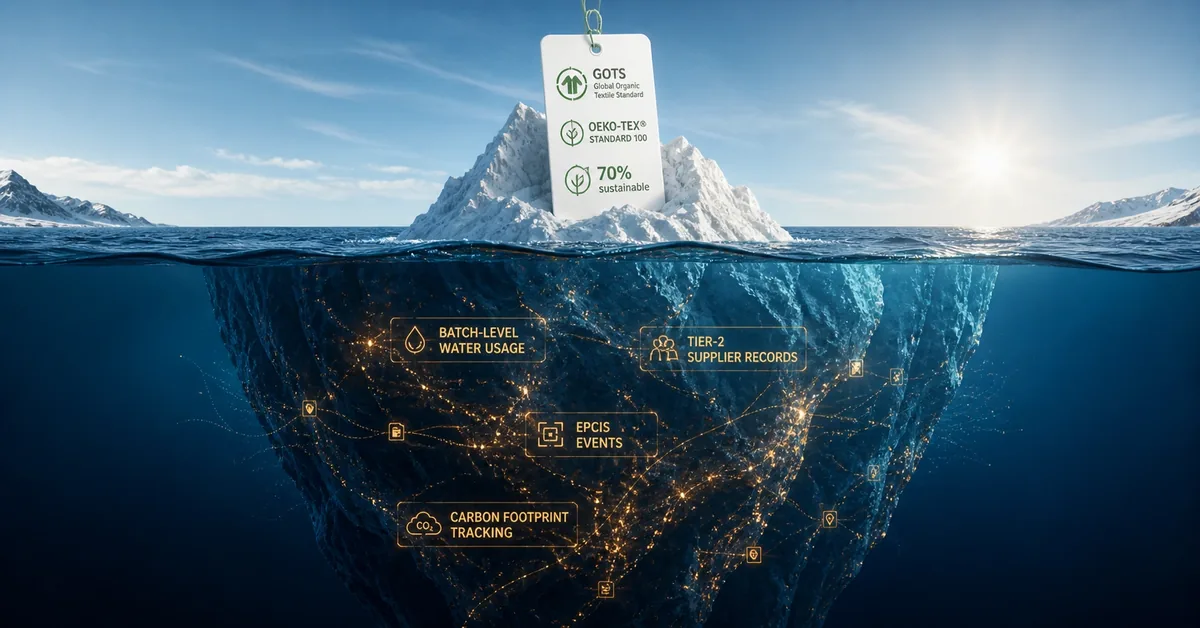
I keep having the same conversation with textile exporters.
They tell me they are working on DPP. They have GOTS certificates. They have OEKO-TEX. Factory audits are clean. They are not worried.
Then I ask a different set of questions.
Can you pull the water consumption figure for a specific batch of fabric? Not factory-level. Batch-level. Can you show me the chain-of-custody records for the recycled polyester in your last shipment? Can you tell me which dyehouse processed lot number 2024-JUL-0441, and whether that dyehouse has signed compliance documentation sitting in a system you can query?
The room gets quieter.
This is not a criticism. It is the actual gap. Most Indian garment exporters have roughly 60% of what EU DPP requires. The 40% they are missing is not the obvious stuff. It is specific, granular, and lives upstream from where most compliance conversations happen.
Here is a category-by-category breakdown of where Indian garment exporters typically stand.
Before going into the gaps, one thing worth grounding: EU DPP is not just a data checklist. It has a specific technical standard behind it. The GS1 DPP Provisional Standard defines the three mandatory data layers any compliant implementation must have: GS1 product identifiers (GTIN, GLN), EPCIS 2.0 supply chain events as the verifiable evidence layer, and a GS1 Digital Link resolver that serves machine-readable data when a product QR code is scanned. If you want the full technical picture of what compliant implementation looks like, that post covers it. This one focuses on the upstream problem: the data that needs to exist before any of those three layers can be built.
The EU DPP mandatory attribute categories for textiles
The ESPR delegated regulation for textiles specifies nine categories of mandatory data. I will go through each one honestly.
This is not a legal read. I am an engineer who builds the systems that have to produce this data. I am telling you where the systems typically break.
1. Product composition and material content
What it requires: Fiber type, percentage by weight, presence of recycled content, raw material sourcing details.
What most Indian exporters have: Fiber composition (yes, almost always). This goes on the label. It is on the test report. Most exporters can produce this.
Where the gap is: Recycled content with chain-of-custody records. There is a difference between “30% recycled polyester” on a spec sheet and “30% recycled polyester verified against a chain-of-custody certificate issued by a credentialed body.” EU DPP requires the second. The GRS (Global Recycled Standard) certificate is the common proof instrument. Some exporters have it. Many do not.
Realistic readiness: 70%
Most exporters have the fiber composition data. They are missing the chain-of-custody backing for any recycled content claims.
2. Durability and reliability information
What it requires: Expected useful life, wash cycle performance data, colorfastness ratings, pilling resistance test results.
What most Indian exporters have: Test reports from accredited labs (SGS, Intertek, Bureau Veritas) covering these parameters. This is standard export documentation.
Where the gap is: The data exists on PDFs. It is not in a system. EU DPP requires this to be machine-readable and linked to a specific product identifier (GTIN). A lab report in a filing cabinet does not satisfy the requirement.
Realistic readiness: 65%
The underlying test data exists. Structuring it and linking it to the digital passport is the missing step.
3. Chemical safety and restricted substances
What it requires: Compliance with REACH and ZDHC MRSL (Manufacturing Restricted Substances List). Chemical inventory documentation for substances used in production. Declaration of no restricted substances above threshold concentrations.
What most Indian exporters have: A facility-level ZDHC compliance report or OEKO-TEX 100 certificate. These are useful. They demonstrate that the factory, in general, meets the standard.
Where the gap is: Lot-specific chemical inventory. EU DPP is moving toward requiring documentation of what chemicals were used in a specific production batch, not just what chemicals the factory is approved to use. These are different claims. Factory-level approval + batch-specific chemical records = compliance. Factory-level approval alone = partial.
This is the gap I see most frequently underestimated. Brands assume OEKO-TEX covers it. It does not cover the batch-specific traceability dimension that ESPR is heading toward.
Realistic readiness: 40%
Factory certifications are common. Batch-level chemical records are rare.
4. Environmental performance: water and energy consumption
What it requires: Water consumption per unit or per kilogram of product. Energy consumption per unit. Ideally broken down by processing stage (dyeing, finishing, washing).
What most Indian exporters have: Factory-level annual sustainability reports, if they have anything at all. Some factories report total water consumption per year. Dividing by production volume gives a rough per-unit figure.
Where the gap is: The EU DPP needs per-unit figures traceable to a specific batch, not an annual average. Batch-level environmental data requires metering at the process level. Most Indian dyehouses and processing units do not have this instrumentation. Even the ones with ISO 14001 certification track environmental metrics at the facility level, not the batch level.
Realistic readiness: 20%
The batch-level environmental data simply does not exist in most operations today. Annual sustainability figures are not a substitute.
5. Country of origin at each processing step
What it requires: Not just “Made in India.” Where was the fiber grown or produced? Where was it spun into yarn? Where was it woven or knit into fabric? Where was it dyed and finished? Where was the final garment assembled?
What most Indian exporters have: A country of origin declaration for customs. This answers the “where was the garment made?” question. It does not answer the processing step question.
Where the gap is: Multi-country supply chains. A garment exported from India may have yarn spun in Bangladesh, fabric woven in India, and finishing done in a separate state. EU DPP asks for step-level origin, not final assembly origin.
Even for fully domestic supply chains, the processing step origin is usually in people’s heads and supplier contracts. Not in a system.
Realistic readiness: 35%
Single-country, vertically integrated exporters are in decent shape. Multi-tier or multi-country supply chains have a significant gap.
6. Tier-2 supplier compliance documentation
What it requires: Compliance documentation from yarn spinners, dyehouses, fabric mills, trim suppliers. Not just your direct (Tier-1) suppliers. Their suppliers.
What most Indian exporters have: Direct supplier audit reports. The factory your purchase order goes to probably has a SMETA audit or equivalent. Their sub-suppliers may have nothing.
Where the gap is: Almost everywhere. Tier-2 engagement is the hardest operational problem in DPP compliance. You do not have a commercial relationship with your supplier’s supplier. You cannot require them to produce EPCIS events. Getting them to share compliance documentation in a structured format requires a different kind of outreach entirely.
Getting Tier-2 supplier data is a supplier engagement program, not a software project.
Realistic readiness: 25%
Direct supplier documentation is reasonably common. Tier-2 documentation in structured, retrievable form is rare.
7. Repairability and end-of-life information
What it requires: Repair instructions, spare parts availability, disassembly instructions, recyclability classification.
What most Indian exporters have: Essentially nothing, unless they have already started EU market-specific product development.
Where the gap is: Most Indian garment exporters are not designing with end-of-life in mind. This is a product design question as much as a data question. Instructions for repair and disassembly need to exist before they can be documented.
Realistic readiness: 15%
Only exporters who have deliberately built EU-oriented product lines are likely to have any of this.
8. Supply chain events (EPCIS traceability record)
What it requires: A structured event history for each product. Who produced it, when, at which location. Who shipped it, when. Who received it. Linked to the digital passport via EPCIS 2.0 events and a GS1 Digital Link resolver.
This is the layer I covered in detail in the GS1 DPP Provisional Standard breakdown.
What most Indian exporters have: Shipment records. Purchase orders. ERP data. None of it in EPCIS format.
Where the gap is: Almost total. Very few Indian supply chain software systems generate EPCIS events today. The ones that do are rare, and almost none of them have a GS1 Digital Link resolver behind the product QR code.
This is the technical foundation that makes DPP compliance possible. Without it, the other data cannot be linked, served, or verified. And it is harder to build than it looks: getting the data out of the ERP, PLM, and PIM and reconciling it into EPCIS form is the connector problem most DPP platforms underestimate.
Realistic readiness: 10%
The data exists in various forms. None of it is in the format DPP requires.
9. Carbon footprint and greenhouse gas emissions
What it requires: Product-level carbon footprint calculation following the Product Category Rules under ISO 14067 or equivalent. Scope 3 emissions from the upstream supply chain.
What most Indian exporters have: Nothing, or a high-level corporate sustainability report.
Where the gap is: Product-level carbon calculation requires batch-level energy data (see category 4 above) plus Scope 3 emissions from raw material extraction, transport, and processing. This is a data collection problem that starts at the farm or factory where the fiber originates.
Realistic readiness: 10%
A small number of exporters working with EU brands have started this work. For most, it has not begun.
Where that leaves you
Here is the honest picture.
| DPP attribute category | Typical readiness |
|---|---|
| Product composition and material content | 70% |
| Durability and reliability information | 65% |
| Chemical safety and restricted substances | 40% |
| Environmental performance (water and energy) | 20% |
| Country of origin at each processing step | 35% |
| Tier-2 supplier compliance documentation | 25% |
| Repairability and end-of-life information | 15% |
| Supply chain events (EPCIS traceability) | 10% |
| Carbon footprint and GHG emissions | 10% |
The categories that feel comfortable (composition, durability test reports) are the ones the industry has been asked about for 20 years. The categories that are almost empty (EPCIS events, carbon, batch-level environmental data) are the ones EU DPP is actually built around.
Why this matters before mid-2027
The EU DPP regulation for textiles applies from mid-2027. That is 13 months from now.
The EPCIS event infrastructure, the GS1 Digital Link resolver, the supplier data onboarding program: these are 6 to 12 month build timelines. They are not something you start the month before the deadline.
The categories where readiness is below 30% (EPCIS events, carbon, batch-level environmental data, Tier-2 supplier documentation) are not categories you can close quickly. They require system changes and supplier engagement that take time even when you move fast.
The exporters who are comfortable about DPP because they have GOTS and OEKO-TEX certificates are prepared for a regulation that does not exist. The actual regulation asks harder questions.
The hardest ones are the ones that barely come up in most compliance conversations today. For what those harder questions look like when they land in a real 2026 PO, see Your EU buyer’s DPP RFQ is already on its way.
A question for people doing this work on the ground right now: which of these nine categories is causing the most friction in practice? My guess is that Tier-2 supplier documentation and batch-level environmental data are the two that keep getting pushed back. But I could be wrong about the priority order. What are you seeing?
Vishal Shukla is the Founder of Brevitaz Systems, which builds GS1 EPCIS-based traceability infrastructure. We are a core contributor to OpenEPCIS, the open-source EPCIS 2.0 implementation led by benelog GmbH. We played the primary role in architecting the backend for a Food Traceability Platform operated by GS1 Germany and Benelog GmbH, running across 770+ enterprises in Europe.